Hot Topics: Now Open: 2013 On the Rise Nominations | Goin' Mobile at the Daily Report | Conn. court: Lawyers can't be sued for fraud
Monday, May 20, 2013
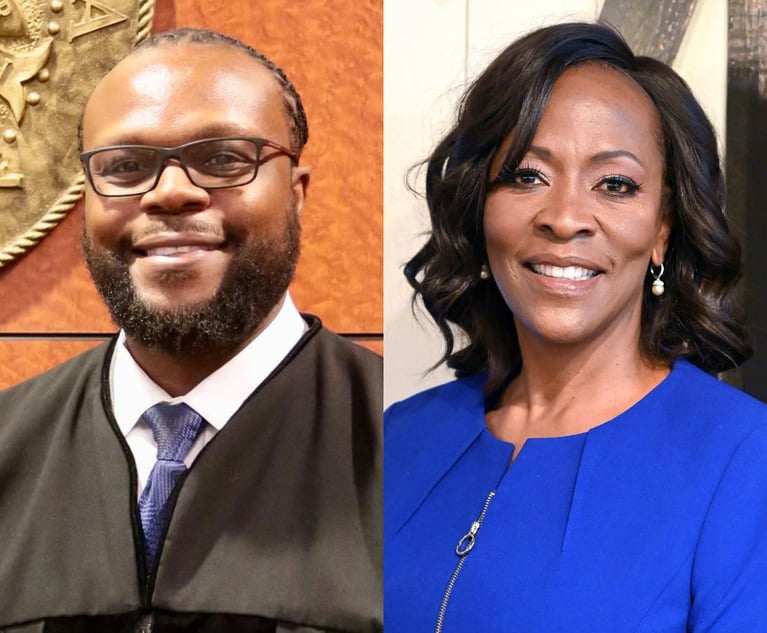
A week of bickering between a DeKalb County judge and the district attorney ended with another DeKalb judge saying he would rule in his colleague's favor - and then recusing from the case. DeKalb Superior Court Judge Daniel Coursey (above) listens during Friday's hearing on a suit against a fellow judge. Later, Coursey recused, citing a JQC regulation on not ruling on a colleague's case.
Following a series of judicial rulings that dramatically reduced the scope of a multicount legal malpractice case down to a single claim, a Fulton County jury found no liability against Atlanta attorney Louis Cohan and his former firm, now-defunct Weinstock & Scavo.
Atlanta Public Schools don't have to respond to prosecutors' subpoena for students' records related to criminal allegations of school officials cheating on standardized tests - at least not for now.
A federal judge has ruled that the estate of late entrepreneur and Internet activist Aaron Swartz may release to Congress and the public some of the information gathered by the lawyers preparing his defense in his hacking case.
The NLJ's Marcia Coyle examines four landmark U.S. Supreme Court cases on health care, money in elections, guns and race in this exclusive excerpt from The Roberts Court: The Struggle for the Constitution.
Back in February, President Barack Obama indicated in his State of the Union address that 3-D printing may be the next big thing in manufacturing. What he didn't say is that 3-D printing may also be the next big thing in intellectual property disputes.
Monday, May 20, 2013
Georgia Court of Appeals, Criminal Case
The State's two nolle prosequis of the defendant's two previous indictments did not preclude the subsequent prosecution for the same offenses under O.C.G.A. § 17-7-53.
CRIMINAL PRACTICE:Nolle Prosequi, Demurrers, Indictment
Georgia Court of Appeals, Civil Case
The Georgia Uninsured Motorist Statute applied to the insurance policy that was issued and delivered in Indiana, since Georgia was the principal location of risk, the insurance company was licensed in Georgia, and the vehicle the plaintiff was driving was garaged and principally used in Georgia.
INSURANCE LAW:Uninsured Motorist Benefits, Coverage; CIVIL PRACTICE:Foreign Law
Georgia Court of Appeals, Criminal Case
In the defendant's trial for child molestation, the trial court properly allowed evidence of the defendant's alleged molestation of 12-year-old twins at an overnight birthday party in 1984 when he was 14 years old, since his conduct in sexually abusing minors in the middle of night while the household was asleep was sufficiently similar to constitute similar transaction evidence, each twin's testimony corroborated the other's and the defendant was old enough to have been held criminally responsible at the time of the incident.
CRIMINAL PRACTICE:Child Molestation; EVIDENCE:Similar Transaction, Impeachment, Prior Bad Acts
Georgia Court of Appeals, Criminal Case
The trial court properly denied the defendant's motion for an out-of-time appeal since he did not allege that his failure to file a timely appeal was due to any ineffective assistance of counsel.
APPEALS:Out-of-Time Appeal; CRIMINAL PRACTICE:Effective Assistance of Counsel
Georgia Court of Appeals, Civil Case
The trial court properly granted summary judgment against all the defendants, even though the summary judgment motion referred to the "Defendant" in the singular, since the motion was served on all the defendants, the issues developed in determining liability were the same for all the defendants, the individual defendants were not surprised by the motion and they were allowed to submit lengthy individual defenses to the motion.
CREDITORS AND DEBTORS RIGHTS:Suit on Note, Deficiency, Foreclosure; CONTRACTS:Fraud, Duress; CIVIL PRACTICE:Standing, Summary Judgment
Georgia Court of Appeals, Criminal Case
The trial court properly dismissed the defendant's out-of-time motion to withdraw his guilty plea to a firearms offense, since the trial court lacked jurisdiction to rule on the motion as the defendant filed it more than 10 years after the expiration of the term of court in which his judgment of conviction was entered.
APPEALS:Out-of-Time Appeal, Jurisdiction; CRIMINAL PRACTICE:Firearms Offense, Effective Assistance of Counsel
Monday, May 20, 2013
Shareholder activists are flexing their muscles with a new exuberance this proxy season, running more insurgent slates in proxy contests, stalking larger targets and enjoying a higher rate of success.
Much of the discussion in the media on whether the surviving Boston bombing suspect should have been given Miranda warnings when he was arrested appears to be based on a misconception: that law enforcement officers are required to give suspects the warnings set forth in Miranda v. Arizona and that failure to do so is a violation of the law, at least if the public-safety exception doesn't apply. That is not correct.
Attorneys have many options when it comes to purchasing legal malpractice insurance.
The attack in Boston will no doubt be examined for a long time to come. Sponsors and organizers of large public events will have to take notice of the results of that analysis and adjust security procedures accordingly.
In Noel Canning v. NLRB, the U.S. Court of Appeals for the D.C. Circuit ruled that President Obama's three January 2012 recess appointments to the National Labor Relations Board were invalid, resulting in an absence of a quorum for the NLRB to conduct business.
No case in recent history has impacted the portability of rainmakers at law firms more than Jewel v. Boxer, 156 Cal. App. 3d 171, 203 Cal. Rptr 13 (Cal. Ct. App. 1994). Since Jewel, law firms and individual attorneys have debated exactly how, and more importantly whether, to mitigate its impact.
Oral arguments at the Georgia Supreme Court by James Cobb for the Appellants. Trip Network (Doing Business as "Cheaptickets") et al. v. Dempsey, Judge, et al.
These six firms presented the best evidence that they won results for clients in 2012, whether it was in favorable verdicts, dismissals, settlements or other actions that protected clients' interests. Read More...