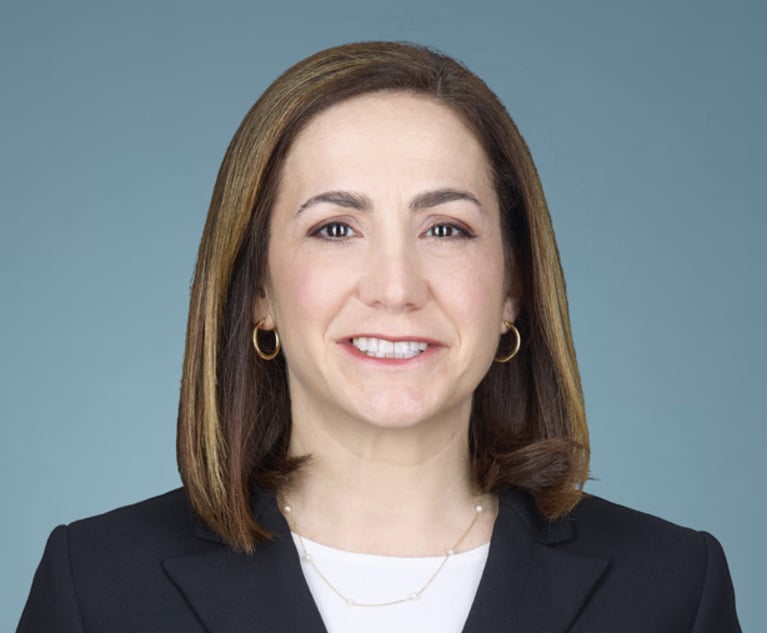
Leah Ward Sears is a partner in Schiff Hardin's Atlanta office, where she is the leader of the firm's national appellate client service team. She is the former chief justice of the Supreme Court of Georgia.
I serve on the board of directors of The Institute for American Values, a private, nonpartisan organization devoted to research, publication and public education on issues of family well-being and civil society. The Institutewhose president is David Blankenhorn, a key witness against gay marriage in the Proposition 8 trial in California in 2010announced last week that it would no longer participate in the debate about same-sex marriage.
The Institute's message was declared in a letter titled, "A Call for a New Conversation on Marriage," which I signed along with more than 70 other signatories, including scholars, theologians, journalists and public intellectuals. In the letter, the Institute renounced the culture war that somebut not allof its members were a part of, in favor of the pro-marriage/healthy family agenda that was the original purpose of the Institute.
Stated another way, the Institute, which has long had members from both sides of the gay marriage debate, is determined to shift its energies to saving the institution of marriage, regardless of whom one chooses as a mate. Whether a person is straight or gay, bisexual or transgender, we are saying, the challenge is to figure out how to strengthen marriage and our families for the broader benefit to society.
I'm pleased with the direction the Institute is taking. Unlike David, I was never against same-sex marriage. But much like David, I've witnessed the fallout from broken families in the past several decades, during which divorce and out-of-wedlock births have skyrocketed, and unstable, serial cohabiting relationships have become the norm for raising children.
I've also long been concerned, particularly from my vantage point when I was a judge, that marriage in America today is fracturing along class lines, contributing to growing inequality and a more insecure middle classa problem that has nothing to do with sexual orientation.
I joined the board of directors of the Institute because I believe that this trend, like any trend, is not preordained, nor is it immune from human decision-making. This is the United States of America, after all. We are naturally leaders, innovators and problem solvers. We can confront this challenge and make healthy marriage achievable for all who seek it.
Our group will continue to focus on the disintegration of marriage, particularly in the middle and lower classes, which, research shows, is creating a new underclass of inequality.
As it happens, more well-educated people tend to stay married, while the less educated and poor are becoming a subculture of economically depressed, single-parent families. Children from such homes have a harder shot at happiness and well-being and are at a higher risk for a variety of negative outcomes such as behavioral problems, incarceration, teen pregnancy and substance abuse, to name just a few. That is unacceptable, and should be bothersome to us all.
My good friend and social critic, Barbara Dafoe Whitehead, author of the influential 1993 Atlantic Monthly magazine cover story, "Dan Quayle Was Right," says that "America can't be a united society if it splits into separate and unequal classes of marriage haves and have-notsand that's what's rapidly happening."
In an op-ed published in The New York Times last summer, David Blankenhorn wrote: "Once we accept gay marriage, might we also agree that marrying before having children is a vital cultural value that all of us should do more to embrace? ... Can we agree that, for all lovers who want their love to last, marriage is preferable to cohabitation?"
-
David S. DeLugas
I agree. While addressing marriage, as a society, we must also put energies and NEW ideas into how our divorce and custody laws contribute to the incidence of divorce and the conditions under which children of divorce are treated, contributing to the very woes Justice Sears identifies.
Comments are not moderated. To report offensive comments, click here.


Reader Comments